
Why Most Nigerians Run Out Of Money Halfway Through Building Their House.
Why Most Nigerians Run Out of Money Halfway Through Building Their House
The "Finish-to-Finish" Trap: Why Your Budget is Lying to You
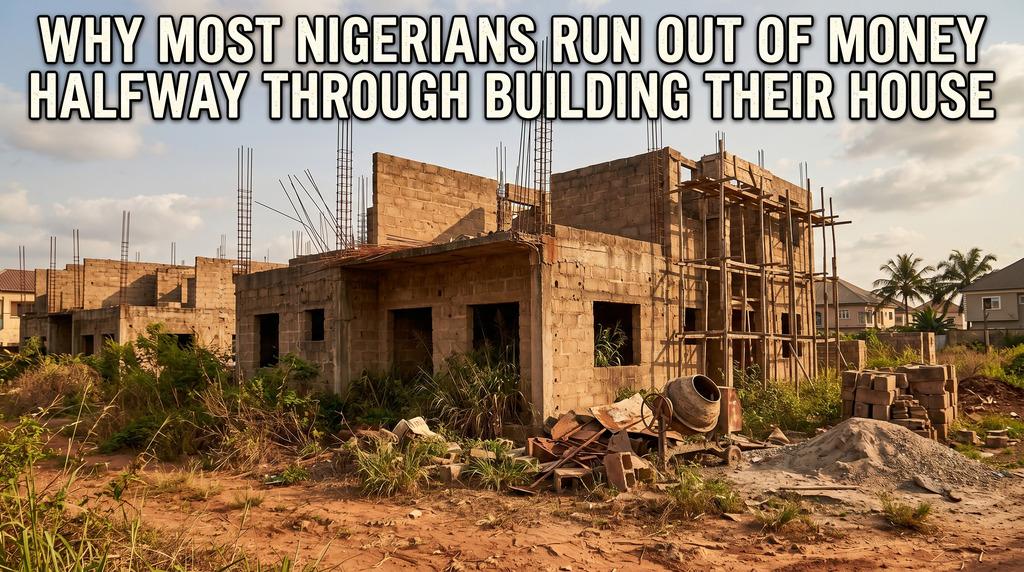
We’ve all seen them. The "skeleton" houses scattered across Ikorodu, Mowe-Ibafo, or the outskirts of Abuja. Roofless, windowless, and abandoned for years.
Many people start with ₦20M in the bank, thinking they’ll be moving in by December. By June, they are struggling to buy a single bag of cement. As a professional in this field, I see the same mistakes repeated every single day.
If you don't want your house to become a "monument" for goats and weeds, here is why your money might disappear halfway:
1. The "Spirit of Finishing" vs. The Reality of Rough Work
Most Nigerians budget for the "structure"—blocks, sand, cement, and roofing. They forget that finishing is where the real money lives.
The Reality: The carcass (foundation to roofing) usually takes about 40–50% of the budget.
The Trap: Tiling, POP, electrical wiring, plumbing, and painting take the other 50–60%. People get excited when the roof goes up, thinking they are "almost done," only to find out they haven't even started spending the big money.
2. Soil Blindness (The Foundation Money-Pit)
Many builders refuse to do a proper soil test because it costs ₦150k–₦1M. They prefer to "estimate."
Then they start digging.
Suddenly, they realize the ground is swampy or too soft. What was supposed to be a simple strip foundation becomes a Raft Foundation or Piling. Boom! Your budget just increased by ₦5M before the first block was even laid.
3. The "OWO Omo-Onile" and Community Tax
If you don't factor in "settlement," your project will stop. From "signing of documents" to "foundation fee," "decking fee," and "roofing fee," these community levies can drain hundreds of thousands that were never in the spreadsheet.
4. Material Inflation and the "Naira Factor"
In Nigeria, the price of cement in the morning isn't always the price in the evening.
2024–2025 Lessons: We saw cement jump from ₦9,000 to ₦13,000+ in some areas within months.
Iron Rods: Don't even get me started on the price of T12 or Y16 rods.
If you aren't buying your materials in bulk or at least "locking in" prices with trusted suppliers, inflation will eat your project alive.
5. The "God Will Provide" Construction Strategy
This is the biggest killer. People start building a 5-bedroom duplex when they only have the money for a 3-bedroom bungalow, hoping that "more money will come" while the project is on.
Construction doesn't care about your faith; it cares about your cash flow. If the money stops, the cement hardens, the wood rots, and the rain washes away your efforts.
How to Avoid Being a "Halfway Builder"
Use a Quantity Surveyor (QS): Stop using your "trusted mason" to estimate costs. Get a professional Bill of Quantities (BOQ). It will tell you the exact number of bags, rods, and trips of sand you need.
Build in Phases: If you don't have the ₦50M+ needed for a full build, start with a "Pay-As-You-Go" approach. Finish the foundation, let it rest. Save up. Do the blockwork.
Prioritize Function over Luxury: You can move into a house with basic tiles and "all-white" paint. You don't need the most expensive Italian marble or gold-plated chandeliers on day one.
On-Site Security: Theft is a silent budget killer. Bags of cement and electrical wires have "legs" on Nigerian sites. If you aren't there or don't have a solid security plan, you’re buying materials for the whole neighborhood.
What about you? What’s the biggest "unforeseen" expense you’ve faced while building? Let's discuss below.
Why Most Nigerians Run Out of Money Halfway Through Building Their House
The "Finish-to-Finish" Trap: Why Your Budget is Lying to You
We’ve all seen them. The "skeleton" houses scattered across Ikorodu, Mowe-Ibafo, or the outskirts of Abuja. Roofless, windowless, and abandoned for years.
Many people start with ₦20M in the bank, thinking they’ll be moving in by December. By June, they are struggling to buy a single bag of cement. As a professional in this field, I see the same mistakes repeated every single day.
If you don't want your house to become a "monument" for goats and weeds, here is why your money might disappear halfway:
1. The "Spirit of Finishing" vs. The Reality of Rough Work
Most Nigerians budget for the "structure"—blocks, sand, cement, and roofing. They forget that finishing is where the real money lives.
The Reality: The carcass (foundation to roofing) usually takes about 40–50% of the budget.
The Trap: Tiling, POP, electrical wiring, plumbing, and painting take the other 50–60%. People get excited when the roof goes up, thinking they are "almost done," only to find out they haven't even started spending the big money.
2. Soil Blindness (The Foundation Money-Pit)
Many builders refuse to do a proper soil test because it costs ₦150k–₦1M. They prefer to "estimate."
Then they start digging.
Suddenly, they realize the ground is swampy or too soft. What was supposed to be a simple strip foundation becomes a Raft Foundation or Piling. Boom! Your budget just increased by ₦5M before the first block was even laid.
3. The "OWO Omo-Onile" and Community Tax
If you don't factor in "settlement," your project will stop. From "signing of documents" to "foundation fee," "decking fee," and "roofing fee," these community levies can drain hundreds of thousands that were never in the spreadsheet.
4. Material Inflation and the "Naira Factor"
In Nigeria, the price of cement in the morning isn't always the price in the evening.
2024–2025 Lessons: We saw cement jump from ₦9,000 to ₦13,000+ in some areas within months.
Iron Rods: Don't even get me started on the price of T12 or Y16 rods.
If you aren't buying your materials in bulk or at least "locking in" prices with trusted suppliers, inflation will eat your project alive.
5. The "God Will Provide" Construction Strategy
This is the biggest killer. People start building a 5-bedroom duplex when they only have the money for a 3-bedroom bungalow, hoping that "more money will come" while the project is on.
Construction doesn't care about your faith; it cares about your cash flow. If the money stops, the cement hardens, the wood rots, and the rain washes away your efforts.
How to Avoid Being a "Halfway Builder"
Use a Quantity Surveyor (QS): Stop using your "trusted mason" to estimate costs. Get a professional Bill of Quantities (BOQ). It will tell you the exact number of bags, rods, and trips of sand you need.
Build in Phases: If you don't have the ₦50M+ needed for a full build, start with a "Pay-As-You-Go" approach. Finish the foundation, let it rest. Save up. Do the blockwork.
Prioritize Function over Luxury: You can move into a house with basic tiles and "all-white" paint. You don't need the most expensive Italian marble or gold-plated chandeliers on day one.
On-Site Security: Theft is a silent budget killer. Bags of cement and electrical wires have "legs" on Nigerian sites. If you aren't there or don't have a solid security plan, you’re buying materials for the whole neighborhood.
What about you? What’s the biggest "unforeseen" expense you’ve faced while building? Let's discuss below.
Why Most Nigerians Run Out Of Money Halfway Through Building Their House.
Why Most Nigerians Run Out of Money Halfway Through Building Their House
The "Finish-to-Finish" Trap: Why Your Budget is Lying to You
We’ve all seen them. The "skeleton" houses scattered across Ikorodu, Mowe-Ibafo, or the outskirts of Abuja. Roofless, windowless, and abandoned for years.
Many people start with ₦20M in the bank, thinking they’ll be moving in by December. By June, they are struggling to buy a single bag of cement. As a professional in this field, I see the same mistakes repeated every single day.
If you don't want your house to become a "monument" for goats and weeds, here is why your money might disappear halfway:
1. The "Spirit of Finishing" vs. The Reality of Rough Work
Most Nigerians budget for the "structure"—blocks, sand, cement, and roofing. They forget that finishing is where the real money lives.
The Reality: The carcass (foundation to roofing) usually takes about 40–50% of the budget.
The Trap: Tiling, POP, electrical wiring, plumbing, and painting take the other 50–60%. People get excited when the roof goes up, thinking they are "almost done," only to find out they haven't even started spending the big money.
2. Soil Blindness (The Foundation Money-Pit)
Many builders refuse to do a proper soil test because it costs ₦150k–₦1M. They prefer to "estimate."
Then they start digging.
Suddenly, they realize the ground is swampy or too soft. What was supposed to be a simple strip foundation becomes a Raft Foundation or Piling. Boom! Your budget just increased by ₦5M before the first block was even laid.
3. The "OWO Omo-Onile" and Community Tax
If you don't factor in "settlement," your project will stop. From "signing of documents" to "foundation fee," "decking fee," and "roofing fee," these community levies can drain hundreds of thousands that were never in the spreadsheet.
4. Material Inflation and the "Naira Factor"
In Nigeria, the price of cement in the morning isn't always the price in the evening.
2024–2025 Lessons: We saw cement jump from ₦9,000 to ₦13,000+ in some areas within months.
Iron Rods: Don't even get me started on the price of T12 or Y16 rods.
If you aren't buying your materials in bulk or at least "locking in" prices with trusted suppliers, inflation will eat your project alive.
5. The "God Will Provide" Construction Strategy
This is the biggest killer. People start building a 5-bedroom duplex when they only have the money for a 3-bedroom bungalow, hoping that "more money will come" while the project is on.
Construction doesn't care about your faith; it cares about your cash flow. If the money stops, the cement hardens, the wood rots, and the rain washes away your efforts.
How to Avoid Being a "Halfway Builder"
Use a Quantity Surveyor (QS): Stop using your "trusted mason" to estimate costs. Get a professional Bill of Quantities (BOQ). It will tell you the exact number of bags, rods, and trips of sand you need.
Build in Phases: If you don't have the ₦50M+ needed for a full build, start with a "Pay-As-You-Go" approach. Finish the foundation, let it rest. Save up. Do the blockwork.
Prioritize Function over Luxury: You can move into a house with basic tiles and "all-white" paint. You don't need the most expensive Italian marble or gold-plated chandeliers on day one.
On-Site Security: Theft is a silent budget killer. Bags of cement and electrical wires have "legs" on Nigerian sites. If you aren't there or don't have a solid security plan, you’re buying materials for the whole neighborhood.
What about you? What’s the biggest "unforeseen" expense you’ve faced while building? Let's discuss below.

 English
 Arabic
 French
 Spanish
 Portuguese
 Deutsch
 Dutch
Dutch
 Italiano
 Russian
 Romaian
 Portuguese (Brazil)
 Greek
Greek